國立成功大學 近海水文中心
Coastal Ocean Monitoring Center, National Cheng Kung University (COMC, NCKU)

Underwater Sound Monitoring System

Underwater ambient noise is an essential background parameter in the fields of underwater acoustics and marine science. By understanding the local underwater noise environment, researchers can conduct studies related to physical oceanography, marine biology, and other scientific disciplines. In addition, such data have practical applications in offshore wind turbine noise monitoring, as well as in surface and underwater vehicle detection and surveillance.
In the early years, underwater acoustic data were mainly collected and transmitted using hydrophones deployed on the seafloor and connected via underwater cables. In recent years, with the continuous advancement of marine technology, international research efforts have increasingly adopted bottom-mounted systems and acoustic buoys for underwater noise monitoring. Among these, acoustic buoys offer significant advantages due to their operational simplicity and ability to transmit monitoring data in real time, making them highly promising for future applications.
Since 2015, the COMC has been developing indigenous underwater acoustic monitoring technology in Taiwan. By integrating data buoys with hydroacoustic instruments, COMC has developed a long-term and real-time Underwater Sound Monitoring System (USMS).
The hydroacoustic equipment developed by the Coastal Ocean Monitoring Center (COMC) consists of several components: a hydrophone (also known as an underwater microphone or underwater acoustic sensor), a signal acquisition module, a signal analysis module, and a data transmission module. All functions related to data acquisition, analysis, storage, and transmission are fully automated. The hydrophone is capable of recording sound frequencies ranging from a few hertz to tens of kilohertz. After signal collection, spectral analysis is performed directly on the buoy, and the processed spectra are then transmitted via the communication module to the central control center for storage and further analysis.
  • Hydrophone: A key sensor used to measure the propagation of sound waves in water.
  • Data Logger (Acquisition Module): Periodically collects hydroacoustic data and stores it on a memory card.
  • Analysis Module: Performs spectral analysis on the collected hydroacoustic data to generate frequency spectra.
  • Transmission Module: Transmits the processed spectra to the central control center via 4G network or satellite communication.
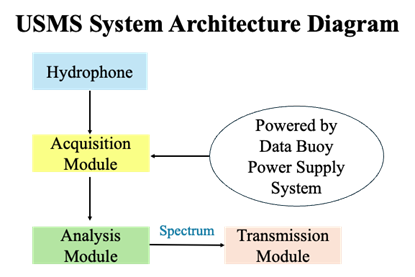
The COMC has integrated its self-developed Underwater Sound Monitoring System (USMS) into data buoys, using these long-term operational buoys as the deployment platform. Through optimized power management and firmware-controlled observation scheduling, the system is capable of conducting continuous at-sea measurements and real-time data transmission for more than one year.
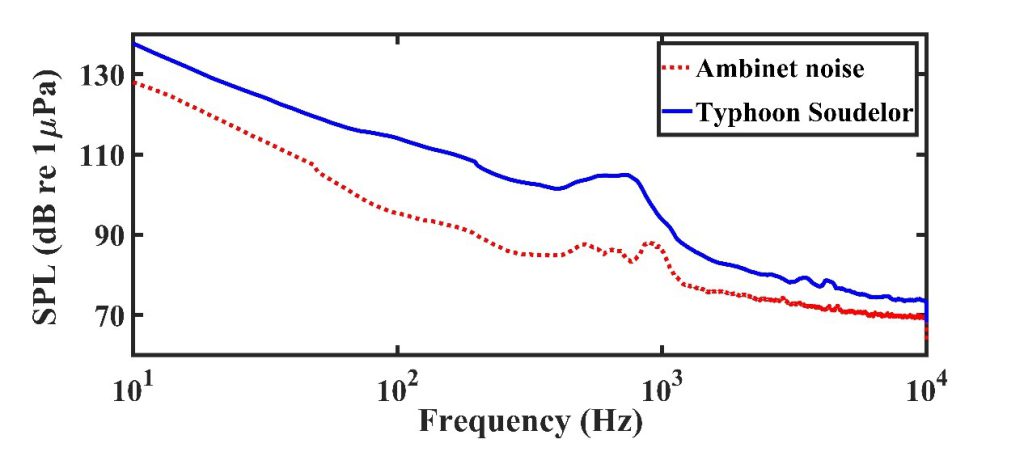
The first data buoy equipped with the USMS was deployed off Qimei, Penghu, on July 16, 2015, successfully providing real-time underwater ambient noise spectra from the site. When Typhoon Soudelor passed through the region on August 8, 2015, the recorded spectra showed significantly higher sound pressure levels compared to periods without rainfall or seismic activity. This confirmed that the USMS developed by COMC not only remained operational under severe marine and meteorological conditions, but also successfully captured the corresponding environmental noise during the typhoon event.
Figure 1. Wave Spectrum Recorded by the Chimei Buoy during Typhoon Soudelor

*Scientific Knowledge
The propagation of sound waves is a form of mechanical vibration in which energy travels through a medium as oscillatory motion. The generation and detection of sound rely on specific materials capable of converting electrical energy into mechanical energy, or vice versa. Such materials are known as electroacoustic transducer materials, and devices designed using these materials are referred to as electroacoustic transducers. A hydrophone is a type of electroacoustic transducer. Its probe detects underwater sound signals through the piezoelectric effect, which enables it to convert mechanical vibrations (sound pressure) into electrical signals. Because the sound signals received by a hydrophone are extremely weak, they must be connected to a charge amplifier to amplify the signal. The amplified signal is then digitized using an analog-to-digital converter and recorded by the data acquisition system for subsequent analysis and processing. Each hydrophone contains sensing elements with distinct sensitivity characteristics, resulting in variations in their frequency response and spatial directivity. Therefore, calibration is required to ensure that the measured sound pressure levels are accurate and reliable.