Coastal Ocean Monitoring Center, National Cheng Kung University (COMC, NCKU)
Tide Observation System
1. Overview
The Tide Observation System adopted by the Coastal Ocean Monitoring Center (COMC) of National Cheng Kung University is based on the concept and technology of the Next-Generation Acoustic Water Level Observation System developed by the U.S. National Oceanic and Atmospheric Administration (NOAA). The system has been modified and enhanced to suit Taiwan’s environmental conditions, and is integrated with a pressure-type tide gauge as a backup to form a locally developed next-generation automatic tide observation system. This new system features significant improvements to the ultrasonic (acoustic) water level measurement principle. By generating an initial acoustic echo at a fixed distance to correct for temperature effects, the system can then accurately calculate the distance to the water surface using the second echo, achieving millimeter-level precision. Through annual precise leveling surveys and instrument calibration, combined with high-precision sensor measurements, the system can accurately monitor sea level variations, providing valuable information for studying land subsidence and sea-level rise caused by climate change.
2. System Architecture and Specifications
The next-generation automatic tide observation system consists of three major components: Observation Unit, Power Supply Unit, and Data Transmission Unit. The Observation Unit includes an acoustic tide gauge, a pressure-type tide gauge, and a data acquisition system. The Power Supply Unit consists of solar panels for charging and lead-acid batteries for power storage. The Data Transmission Unit employs 4G communication technology for real-time data transmission. The system samples data at a frequency of 1 Hz, recording observations every 60 seconds (1 minute) and 360 seconds (6 minutes). The collected data are statistically analyzed to produce real-time tide information, which is transmitted via 4G to the monitoring and quality control center for data verification. After quality control, the processed data are made immediately accessible to end users via the internet. To ensure data stability, both the acoustic tide gauge and the pressure tide gauge are installed inside a stilling well, which filters out short-period wave fluctuations. The 4G modem is housed within the data acquisition enclosure, along with the battery, to protect it from direct sunlight and rainfall. The solar panels are mounted on top of the protective enclosure at a location with good line-of-sight exposure to ensure optimal charging performance. Since the data acquisition system is independently developed by COMC, the new-generation automatic tide observation system can be customized to meet client requirements, and can also be expanded to include meteorological sensors mounted on a meteorological tower.
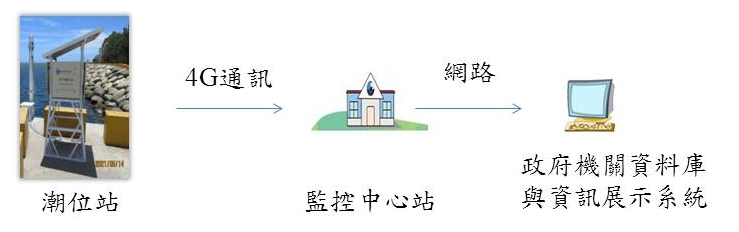
Tide Gauge Data Transmission Framework

Next-Generation Automated Tide Observation System
(Left: Stilling well with acoustic and pressure water level gauges; Right: Data acquisition system and battery protection box; Top: Solar panels)
3. Observation Results
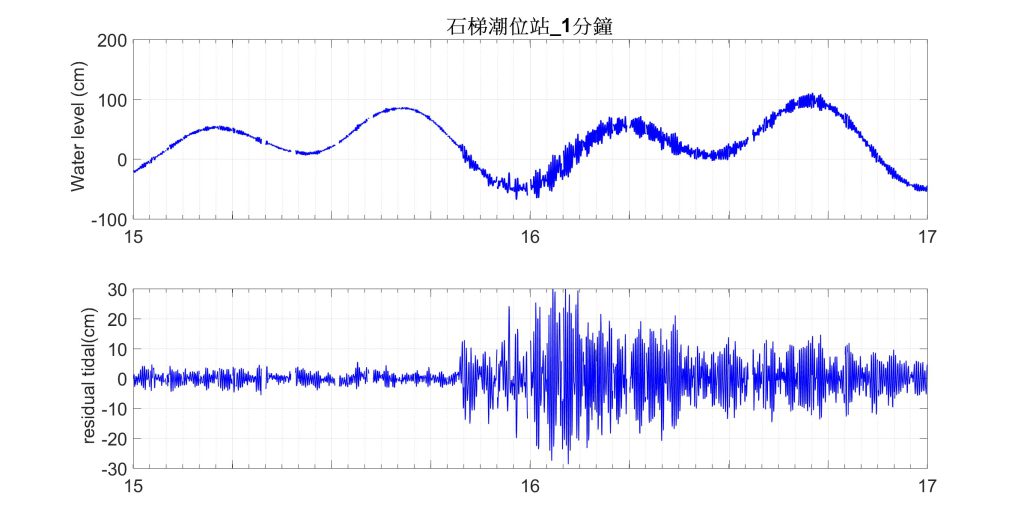
Since 2000, when the Coastal Ocean Monitoring Center (COMC) introduced the system under the commission of the Science and Technology Advisory Office of the Ministry of Transportation and Communications, it has been progressively adopted by national agencies such as the Central Weather Administration (CWA) and the Water Resources Agency (WRA). To date, more than 40 tide stations have been installed along the coasts of Taiwan and its offshore islands. Real-time tide information is transmitted via the internet to both the CWA and WRA, supporting applications such as tsunami monitoring, port navigation and vessel traffic services, and coastal flood prevention and disaster management. At 12:27 p.m. on January 15, 2022, an undersea volcanic eruption occurred near Tonga, which generated a tsunami that propagated to the eastern and southern coasts of Taiwan. At the Shihti Tide Station, operated by COMC under commission from the WRA, a tsunami wave amplitude of approximately 30 centimeters was recorded on January 16.