國立成功大學 近海水文中心
Coastal Ocean Monitoring Center, National Cheng Kung University (COMC, NCKU)
Coastal Ocean Monitoring Center, National Cheng Kung University (COMC, NCKU)
Operational Wave Model
All marine meteorological conditions are closely related to offshore wind farm planning, marine environmental engineering, and the safety of vessel navigation. Understanding the characteristics of the oceanic and atmospheric environment is therefore essential to these activities. The variability of marine meteorological phenomena can be studied through various approaches, such as theoretical analysis, numerical modeling, and observation. Among these, numerical models can forecast future sea states, providing valuable information for scheduling marine engineering operations. Compared with large-scale ocean forecasts aimed at fisheries or navigation, marine engineering requires forecasts with higher spatial and temporal resolution and greater accuracy for specific areas, in order to reduce costs and time. Thus, precise prediction of future sea-state dynamics is essential. From a practical perspective, the Central Weather Administration (CWA) is the governmental authority responsible for meteorological and oceanographic forecasting. While its forecasts serve various societal needs—such as fisheries, recreation, disaster prevention, and navigation—the COMC further refines these forecasts into regional and site-specific ocean condition predictions to meet the requirements of marine engineering projects.
Over the past several decades, wave forecasting methods have evolved from empirical formulations to sophisticated numerical models. Today, the most advanced models are known as third-generation spectral wave models, which include SWAN (Simulation of Waves in Nearshore) developed by Delft University of Technology in the Netherlands, WAM developed by the WAMDI Group led by Hasselmann at the Max Planck Institute in Germany, and WAVEWATCH III, developed by the U.S. National Oceanic and Atmospheric Administration (NOAA). Among these, WAVEWATCH III is the operational model used by NOAA, the UK Met Office, and the Australian Bureau of Meteorology. In 2010 and 2011, COMC assisted the Central Weather Administration in establishing the WAVEWATCH III operational wave model, which has since provided daily updated forecast data. To enhance maritime construction safety and schedule management, COMC has developed high-resolution, regional wind-wave and swell prediction systems, which have been successfully applied to marine engineering projects such as the Linkou offshore works in Taipei, the Hsinta offshore terminal operations in Kaohsiung, and the deep-seawater pipeline installation in the Taitung offshore area.
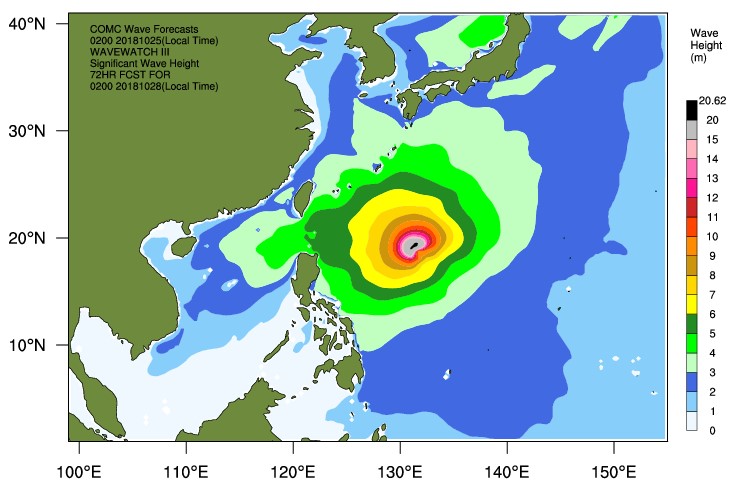
Operational Wave Forecasting System of the Coastal Ocean Monitoring Center (COMC)
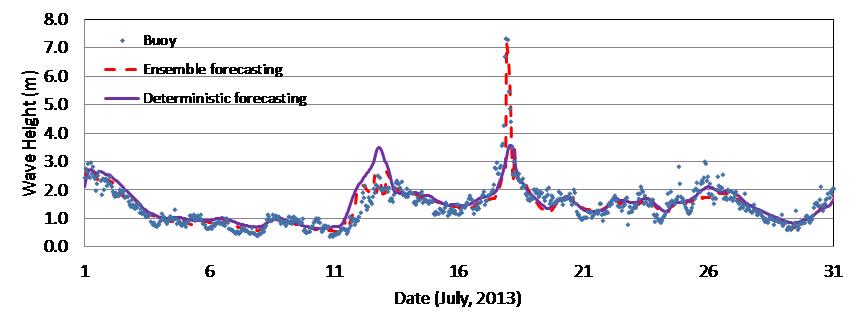
Improving ocean wave forecasting has long been a major goal for marine research and operational institutions worldwide. The most direct approach to improving forecast accuracy is to enhance the numerical model itself—by refining the initial field, increasing model resolution, or incorporating more complex physical parameterization schemes. However, because wave dynamics are inherently chaotic and the numerical prediction process involves nonlinear interactions, errors tend to accumulate within the model, meaning that even small perturbations can lead to large differences in the predicted outcomes, ultimately resulting in forecast inaccuracy. Additionally, uncertainties in the forecasting system—such as errors in the initial data or deficiencies in the model formulation—can further affect prediction results. Deterministic wave forecasting systems, which rely on a single model and a single initial condition to produce one “best” prediction, cannot capture these uncertainties or provide information about their range. Consequently, it is difficult for deterministic forecasts to represent all possible sea-state variations. Since 2011, COMC has developed an operational ensemble wave forecasting system, and in 2012, it further extended its application to typhoon wave forecasting. Results demonstrated that the ensemble wave forecasting approach not only captured trends that matched well with observed wave conditions but also provided more accurate estimates of the timing and magnitude of peak waves, thereby effectively compensating for the limitations of single-model deterministic forecasts.