Coastal Ocean Monitoring Center, National Cheng Kung University (COMC, NCKU)
Costal Freak Waves
1. What are coastal freak waves?

Figure 1. Coastal freak wave case at the Keelung coast (during Typhoon Fung-Wong, 2014)
2. Where and when do freak waves occur?
When the wind fetch is far away from the coastline, nearshore areas may appear calm without significant wave activity. After waves leave the wind generation area, longer-period waves are formed due to the interaction between successive waves; these are also known as swell or long-period waves. When such waves propagate toward the coast, freak waves may occur in the nearshore region, potentially sweeping people into the sea.
In the past, when typhoons (especially intense ones) occurred over the northwestern Pacific Ocean, Taiwan often experienced nearshore freak wave incidents caused by long-period swells. For example, in September 2017, a freak wave event occurred at the Keelung breakwater. Although Typhoon Talim had already turned toward Japan and was about 1,500 km away from Taiwan, swells generated by the typhoon struck participants of a fishing competition on the breakwater, placing more than one hundred fishermen in danger and even sweeping vehicles into the sea. Fortunately, no casualties occurred. In April 2015, a wave attack event occurred near Qixingtan in Hualien while Typhoon Maysak was moving toward the Philippine Sea.
The energy carried by swell-induced freak waves is extremely powerful. In July 2014, when Typhoon Neoguri was about 800 km away from Taiwan, seven tourists near Yehliu Geopark in New Taipei City were injured by sudden large waves despite protective barriers, though no fatalities occurred. In October of the same year, during Typhoon Fung-Wong, a freak wave event was captured on camera and widely reported by the media. The incident occurred when long-period waves reached the breakwater of National Taiwan Ocean University in Keelung, and a passing motorcyclist was swept into the sea.
However, not all events are without fatalities. In October 2012, during Typhoon Prapiroon moving toward Japan, a freak wave event occurred at Wanggong Fishing Harbor in Yilan County, sweeping fishermen and vehicles into the sea, resulting in three deaths and injuries. The most severe freak wave event in Taiwan occurred in November 2013 during Typhoon Haiyan, known as one of the strongest storms on record. About 16 people conducting outdoor teaching activities at the Longdong Bitou Trail in New Taipei City were swept into the sea by a large swell, resulting in 8 deaths and 8 injuries.
These swell-induced freak wave events often occur without warning. Relying solely on typhoon advisory information provided by the Central Weather Administration is insufficient for assessing coastal safety. It is evident that such waves may occur outside the active typhoon warning period. Since swell is a common trigger for freak waves, such events may occur when a typhoon is still far from Taiwan or before/after its passage. During such times, coastal regions may experience fair weather under high-pressure systems, making sudden wave events particularly dangerous.
3. How are freak waves monitored?
Coastal optical observation is one of the potential methods for monitoring freak waves. Installing optical cameras along the coast has the advantages of low cost and ease of deployment. Such image data have been widely used in coastal hazard monitoring, including rip current detection (Brander, 1999; Dalrymple et al., 2011; Akila et al., 2021) and shoreline change analysis (Didier et al., 2017; Pugliano et al., 2019). From a methodological perspective, using optical cameras to monitor coastal freak waves is currently one of the more feasible approaches.
In recent years, the Central Weather Administration has planned and developed a nearshore abnormal wave optical observation system around Taiwan, aiming to establish at least one optical monitoring station in each county for continuous and uninterrupted observation of freak waves. The planned distribution of monitoring stations is shown in Figure 2. Stations marked in blue have been completed, while others are in planning or under construction.
The raw camera images are recorded in full-color RGB format. In this study, the analysis process is simplified by converting images into grayscale. Wave splashes are identified based on variations in gray scale values (GSV). A binary image processing method is applied to separate wave splash regions from the background. By further extracting wave boundaries, wave parameters such as unit water volume, maximum splash height, and water volume variation rate (flow rate) can be obtained, which are used to evaluate whether an event qualifies as a hazardous freak wave capable of knocking people down.
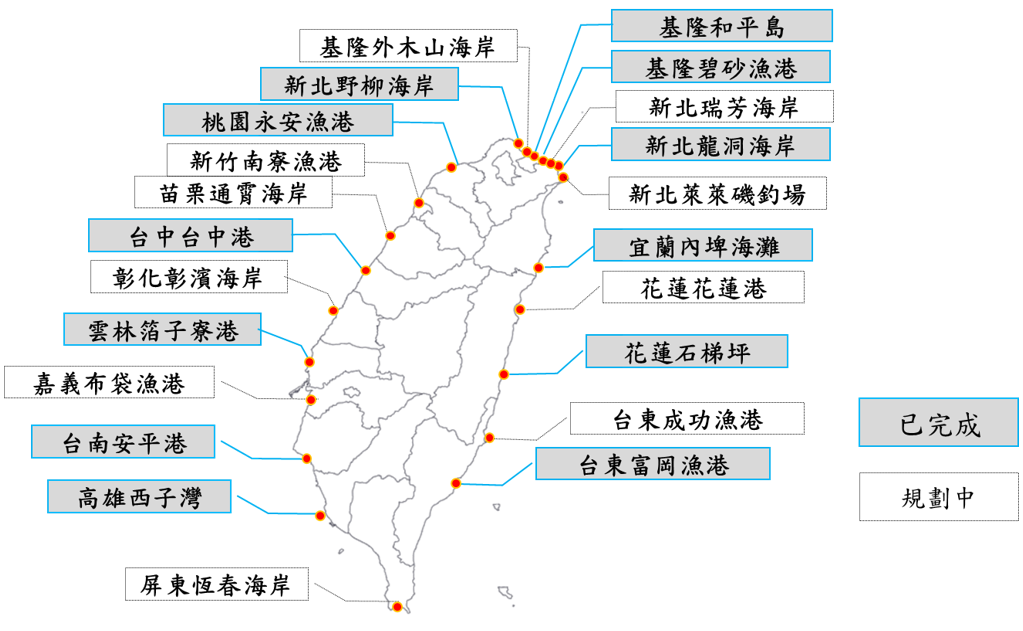
Figure 2. Planned nearshore abnormal wave optical monitoring stations around Taiwan by the Central Weather Administration
What type of wave splash can be defined as a freak wave?
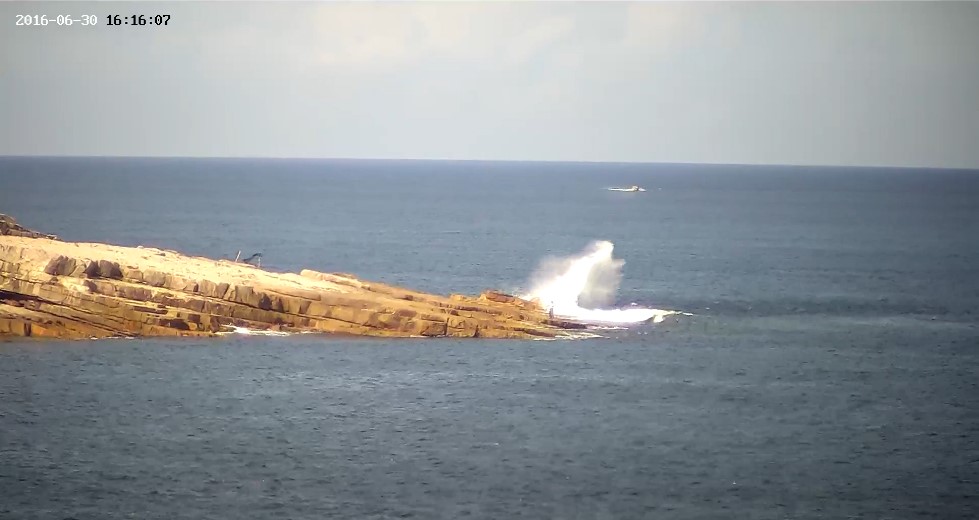
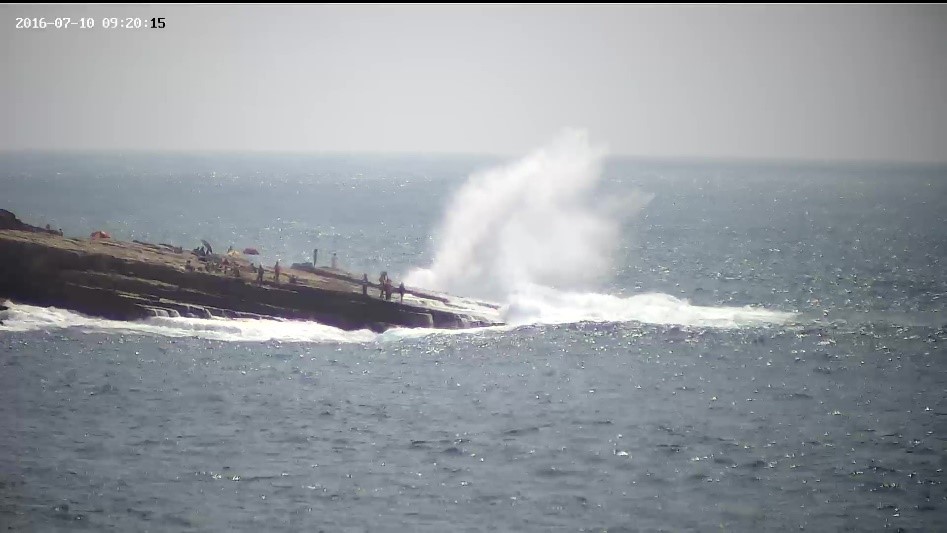
Figure 3 shows a typical freak wave case. In the example recorded at 16:00 on June 30, 2016, a fisherman can be seen standing on a headland under calm sea conditions when a large wave suddenly arrives, exceeding human height. The entire process from wave formation to dissipation was fully recorded by the imaging system. This event can be classified as a typical freak wave case.
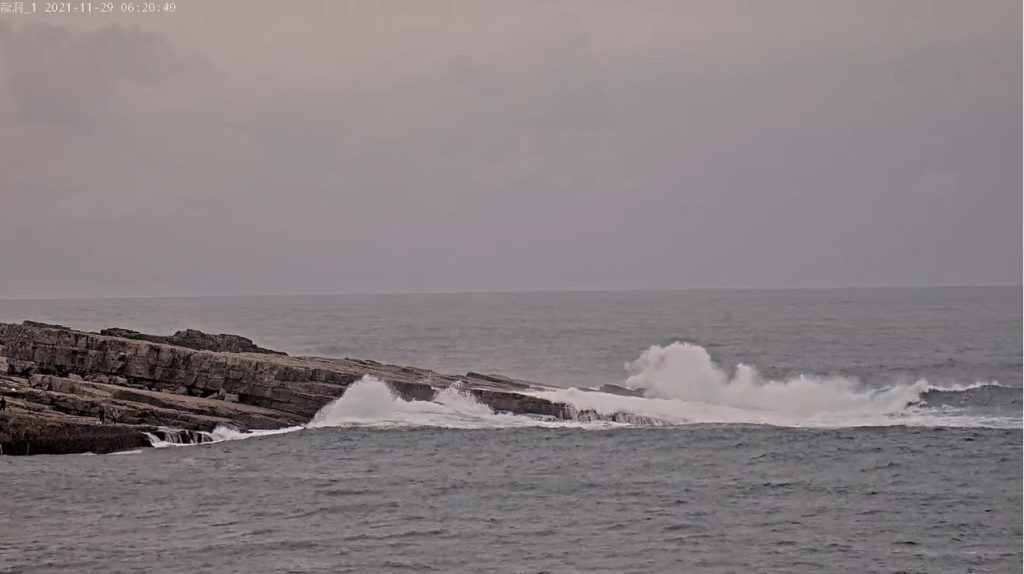
In addition to typical cases, another type of wave phenomenon has been observed. After wave–rock interactions, instead of forming a large splash, water rapidly climbs along the rock surface. Its characteristics resemble wave run-up or even tsunami-like behavior. Such events are also hazardous and are referred to as “run-up type freak waves.” For example, Figure 4 shows an event recorded at 06:20 on November 29, 2021. This type of freak wave does not necessarily produce a large breaking splash. After wave breaking, the water flowing along the reef surface is relatively shallow and less visually distinct in imagery. This behavior differs significantly from the previously discussed wave–reef interaction that generates prominent wave splashes. However, if the flow velocity is sufficiently high, it can still be strong enough to knock a person off balance and sweep them into the sea.
(a) 2016/6/30 16:16
(b) 2016/7/10 09:20
(c) 2022/04/15 17:50
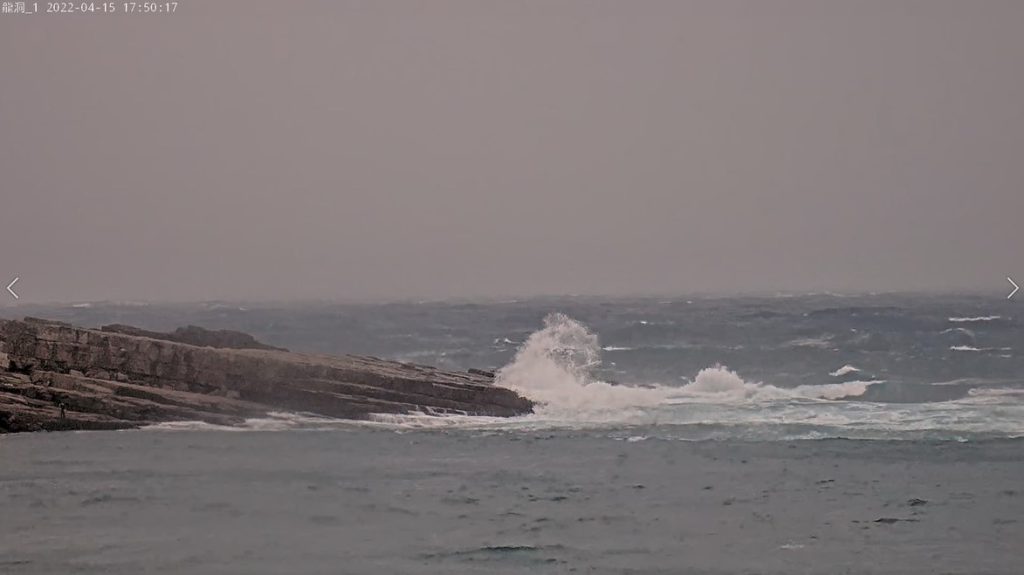
Figure 3. Typical freak wave case at the Longdong coast