國立成功大學 近海水文中心
Coastal Ocean Monitoring Center, National Cheng Kung University (COMC, NCKU)
Coastal Ocean Monitoring Center, National Cheng Kung University (COMC, NCKU)
Current
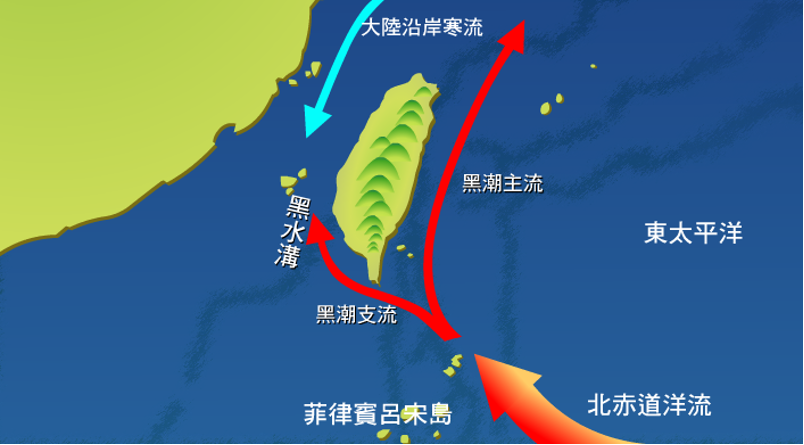
Currents, also known as ocean currents, refer to the large-scale movement of seawater driven by various external forces. There are several mechanisms that generate ocean currents, including wind-driven currents induced by surface winds, geostrophic currents resulting from sea surface slope and the Coriolis effect, tidal currents generated by tidal level differences, and thermohaline circulation driven by variations in water density due to temperature and salinity differences. Among these, large-scale ocean circulation driven by global wind systems and the Earth’s rotation plays a key role in regulating heat exchange between the equatorial and polar regions. Therefore, anomalies in ocean circulation may lead to significant atmospheric impacts and extreme weather events (as dramatized in disaster films such as The Day After Tomorrow). These large-scale circulations persist throughout the year. For example, the Kuroshio Current flows along the eastern waters of Taiwan. Originating from the North Equatorial Current, it passes east of the Philippines, flows past eastern Taiwan, and continues toward Japan. As a warm western boundary current in the Northwest Pacific, its surface velocity can reach approximately 1 m/s. Due to its relatively stable and persistent flow, it has also been widely discussed in the context of marine energy applications. Another important hydrodynamic phenomenon affecting sea level variation is the tide. During tidal fluctuations between high and low water levels, tidal currents are generated. In straits and near headland coastal regions, tidal ranges are more pronounced, and current velocities can become significantly stronger. For instance, in the northern coastal waters near Cape Fugui, maximum current speeds can exceed 3 m/s. Understanding nearshore current characteristics is therefore crucial, as it enables more accurate assessment of drift trajectories for search and rescue operations and the dispersion of oil spills in marine emergency response scenarios.
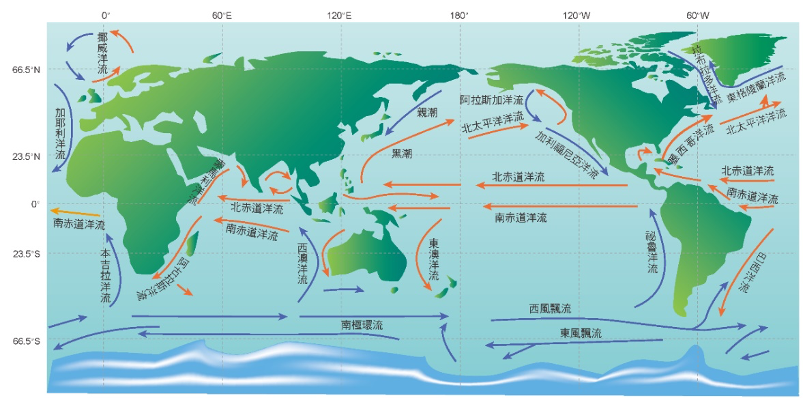
Global surface ocean current map. (Red: warm currents ; Blue: cold currents)
(Source: Central Weather Administration)