
Coastal Ocean Monitoring Center, National Cheng Kung University (COMC, NCKU)
Underwater Sound Monitoring System
- Hydrophone: A key sensor used to measure the propagation of sound waves in water.
- Data Logger (Acquisition Module): Periodically collects hydroacoustic data and stores it on a memory card.
- Analysis Module: Performs spectral analysis on the collected hydroacoustic data to generate frequency spectra.
- Transmission Module: Transmits the processed spectra to the central control center via 4G network or satellite communication.
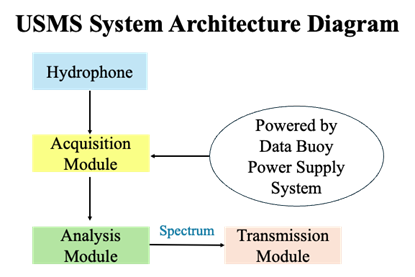
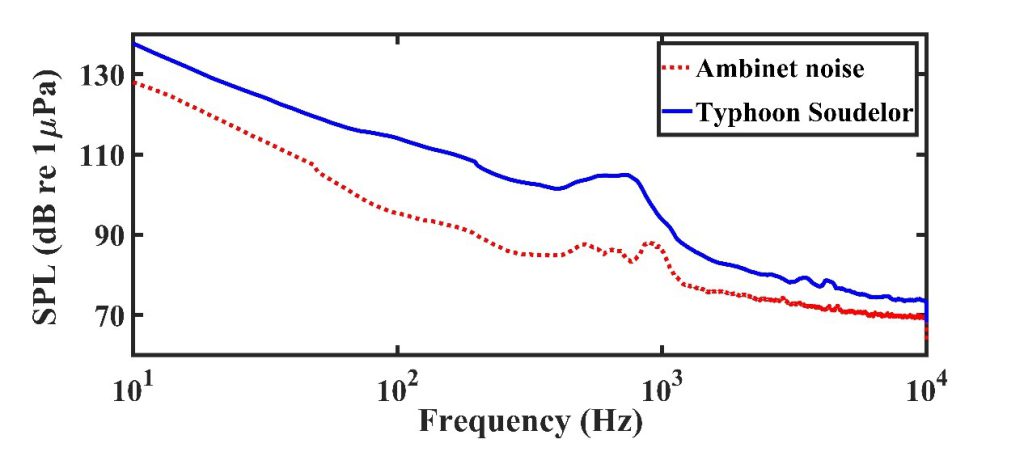
Figure 1. Wave Spectrum Recorded by the Chimei Buoy during Typhoon Soudelor
*Scientific Knowledge
The propagation of sound waves is a form of mechanical vibration in which energy travels through a medium as oscillatory motion. The generation and detection of sound rely on specific materials capable of converting electrical energy into mechanical energy, or vice versa. Such materials are known as electroacoustic transducer materials, and devices designed using these materials are referred to as electroacoustic transducers. A hydrophone is a type of electroacoustic transducer. Its probe detects underwater sound signals through the piezoelectric effect, which enables it to convert mechanical vibrations (sound pressure) into electrical signals. Because the sound signals received by a hydrophone are extremely weak, they must be connected to a charge amplifier to amplify the signal. The amplified signal is then digitized using an analog-to-digital converter and recorded by the data acquisition system for subsequent analysis and processing. Each hydrophone contains sensing elements with distinct sensitivity characteristics, resulting in variations in their frequency response and spatial directivity. Therefore, calibration is required to ensure that the measured sound pressure levels are accurate and reliable.